

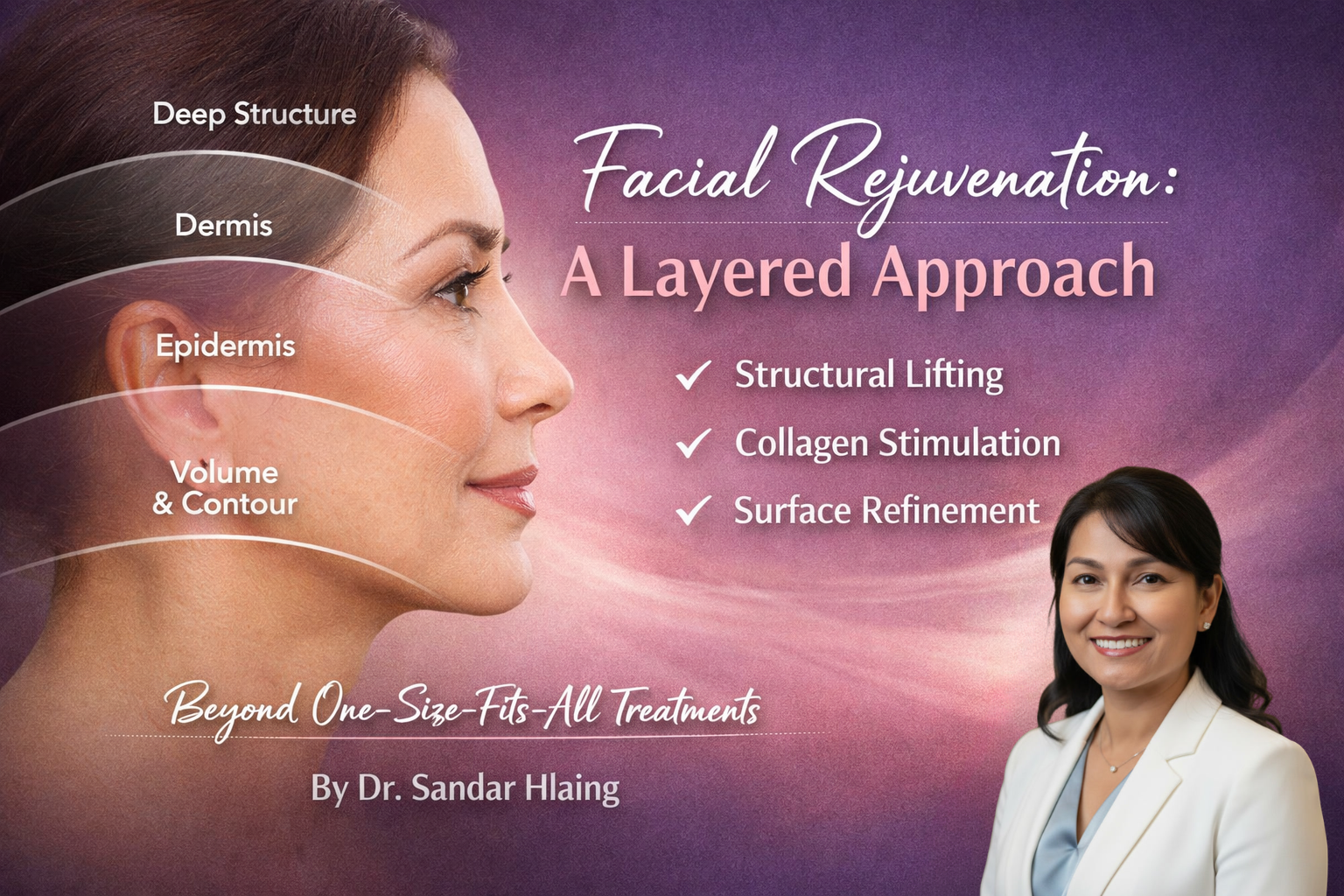
The Future of Facial Rejuvenation: Why a Layered, Stepwise Approach Delivers Superior Results
Facial rejuvenation is often misunderstood.
Many patients come to me having tried individual treatments, sometimes with modest results, sometimes with disappointment. And the reason is usually the same:
Ageing does not happen in one layer, so it cannot be treated with one solution.
Over the years, both clinical experience and medical literature have made one thing very clear to me. If we want natural, long-lasting results, we have to treat the face as a whole, not in fragments.
That is why I follow what I call a layered, stepwise approach to facial rejuvenation.
Understanding How the Face Actually Ages
When I assess a patient, I am not just looking at the skin surface.
I am looking at multiple layers that change over time:
- The deeper structural support system (SMAS)
- The dermis, where collagen and elasticity decline
- The surface of the skin, where texture and pigmentation become uneven
- The gradual loss of fat and bone support, which alters facial contours
Each of these layers ages at a different pace, but they are all connected.
If we only treat one, the result is often incomplete or short-lived.
Moving Away from Isolated Treatments
In the past, aesthetic treatments were often performed in isolation.
A tightening treatment here. A resurfacing treatment there. Perhaps some filler later.
But this approach rarely delivers truly refined results.
In my practice, I focus on combining treatments in a structured and thoughtful way, so they complement each other rather than compete.
This allows me to create outcomes that are:
- More natural
- More balanced
- Longer lasting
It also allows me to tailor each plan to the individual, rather than applying a one-size-fits-all solution.
Why a Layered Approach Works
When treatments are combined correctly, they work in synergy.
Each layer supports the next.
What I typically aim to achieve is:
- Structural support where lifting actually occurs
- Collagen stimulation where the skin needs rebuilding
- Surface refinement where tone and texture can be improved
- Subtle volume restoration where it has been lost
This approach allows the face to be refreshed in a way that still looks entirely like you, just more rested and supported.
Importantly, layering is not about doing more treatments.
It is about doing the right treatments, in the right order.
My Stepwise Approach to Facial Rejuvenation
Step 1: Protect and Optimise Skin Health
Before we begin any advanced treatment, I always look at the basics.
Healthy skin responds better, heals better, and maintains results for longer.
I usually recommend:
- A gentle cleanser to remove daily impurities
- AHA or BHA-based products to improve texture and pores
- Consistent moisturisation to maintain hydration
- Daily SPF 50, often combined with antioxidants like vitamin C
- A low-strength retinol at night, if appropriate
I also emphasise simple but important habits:
- Staying well hydrated
- Getting adequate sleep
- Avoiding smoking
- Protecting the skin from excessive sun exposure
These may sound simple, but they form the foundation of everything that follows.
Step 2: Strengthen the Structural Foundation
One of the most important changes with ageing is the loss of structural support.
This is where treatments like HIFU (High-Intensity Focused Ultrasound) play a key role.
HIFU allows me to target deeper layers of the face, including the SMAS, where true lifting occurs.
By stimulating collagen and creating controlled tissue contraction, I can achieve:
- Better jawline definition
- Subtle lifting of the lower face
- Reduction in jowls
- Gentle brow elevation
I often describe this step as building the framework. Without it, other treatments have less impact.
Step 3: Improve Skin Quality at a Deeper Level
Once the structure is supported, I focus on the quality of the skin itself.
The dermis is where we see:
- Loss of elasticity
- Fine lines
- Changes in texture
Using technologies such as radiofrequency-based treatments like 3D Emlift, I can stimulate collagen and improve muscle tone without damaging surrounding tissue.
Patients typically notice:
- Firmer skin
- Better elasticity
- Smoother texture
- A more radiant appearance
This is often the stage where patients begin to feel that their skin looks healthier, not just tighter.
Step 4: Refine the Surface
After addressing deeper layers, I then focus on the surface of the skin.
Depending on the individual, I may recommend:
- Medical-grade chemical peels
- Microneedling at tailored depths
- Regenerative treatments such as PRP or exosomes
These treatments help to:
- Improve pigmentation
- Refine texture
- Enhance overall skin clarity
This step is about achieving that final level of polish, where the skin looks bright, even, and refreshed.
Step 5: Restore Volume Where Needed
Finally, I assess whether there has been any loss of volume or contour.
If appropriate, I may use:
- Hyaluronic acid fillers to restore natural volume
- Thread lifts to support and reposition tissue
These are always used conservatively and strategically.
My goal is never to change how someone looks, but to restore balance and softness in a very natural way.
Why This Approach Matters
For me, aesthetic medicine is not about quick fixes.
It is about understanding the face, respecting its structure, and creating results that are subtle, elegant, and long-lasting.
A layered approach allows me to do exactly that.
It means:
- Treatments are more predictable
- Results look more natural
- Patients feel more confident in the outcome
Final Thoughts
The future of facial rejuvenation is not about a single treatment or a trend.
It is about clinical understanding, careful planning, and thoughtful execution.
When we treat the face in layers, we are no longer chasing individual concerns.
We are creating harmony.
And in my experience, those are always the most beautiful results.

